
Beyond the Algorithm: Humanity’s Defining Choice in the Age of AI
What it means for humanity to take the lead and an invitation to an upcoming event.

More than a technical evolution, AI is a civilizational check point.
AI offers promising benefits from improved efficiency and accelerated research to enhanced decision-support systems and new avenues for economic participation. Yet misaligned or misused AI can, among others, amplify structural inequalities and embedded bias, erode privacy, generate new vectors for misinformation and cognitive manipulation, disrupt labor markets, intensify environmental strain, and gradually lead to the atrophy of critical reasoning, creativity, human agency, social relations, and trust.
These risks are profound. Addressing them require a holistic understanding of the relationship between technology and its broader social impact, the roles different actors can play in this dynamic, and how they can meaningfully come together to ensure a pathway towards responsible scaling for collective good. The urgency is heightened as AI becomes increasingly embedded across public and private domains, including in high-stake contexts.
More than “what AI can do”, the path ahead requires answering the harder questions, for example:
Who defines the objectives that AI systems optimize for, and through what legitimacy?
How do we ensure AI is fit for purpose across diverse political, economic, and social contexts?
How do we protect the most vulnerable, especially in high-stake decisions?
How do we protect and properly steward human talents so AI augments instead of replaces them?
How do we translate value principles into measurable collective actions across AI lifecycle?
How do we ensure good design is matched with adequate user knowledge and governance?
What does accountability look like when decision-making is partially automated and distributed across actors?
What should a desirable future look like if AI adoption is aligned with diverse human needs?
Answering these questions requires moving beyond an efficiency-driven mindset toward a proactive and structured commitment to human dignity, agency, equity, and long-term visions as foundational principles. A human-centered orientation asks not only whether a system performs accurately, but whether it advances human agency, protects dignity, strengthens social trust, and contributes to inclusive prosperity. It requires clarity about the kind of societies we seek to cultivate and aligning technological deployment with that vision through intentional efforts.
At the core, humanity has to be the North Star.
This isn’t rhetoric, but a reality check for the direction our societies are taking with long-term implications that extend far beyond this generation.
The good news is we are already witnessing increased emphasis and efforts on this imperative across multilateral forums, global dialogues, and local initiatives. The discourse is maturing, though the real test ahead lies in how well we can execute.
Responsible AI means value-embedded stewardship across the entire lifecycle - from clear articulation of purpose and problem framing, to interdisciplinary design, structured deployment with defined accountability under sound governance, and continuous monitoring, inclusive feedback, and adaptation.
It is a collective undertaking, with social impact contingent on the quality of cooperation. The complexity of AI’s technological-societal entanglement necessitates stronger and more resilient forms of cooperation that can match the scale, speed, and interconnectedness of the shifting reality. It demands a whole-of-society approach with each actor occupies a distinct but interdependent role within the larger ecosystem, and investment in social infrastructure that enables responsible adoption over time. At minimum, this includes cross‑domain synthesis, alignment with diverse contextual realities, digital literacy at institutional and societal scale with intensity matched to responsibility, human-flourishing–oriented talent development and stewardship, inclusive policymaking, responsible resourcing, and placing vulnerable communities at the center of decision-making rather than at its margins.
Responsible AI is not a destination. It is a continuous negotiation between technological possibility and societal purpose. Rather than blind optimism or ungrounded fear, this moment calls for deep critical reflection, sober awareness on the impact of our choices, and courage as well as imagination to work together across differences. The real measure of progress isn’t how powerful our systems become, but how well they advance what’s the most important for humanity - this goal is what we should have been striving for all along.
AI’s trajectory remains open. Can we pass the test?
On March 18, I will be giving a dedicated session on “Humanity in the AI Era” at IEEE Future Networks to explore these themes in greater depth.
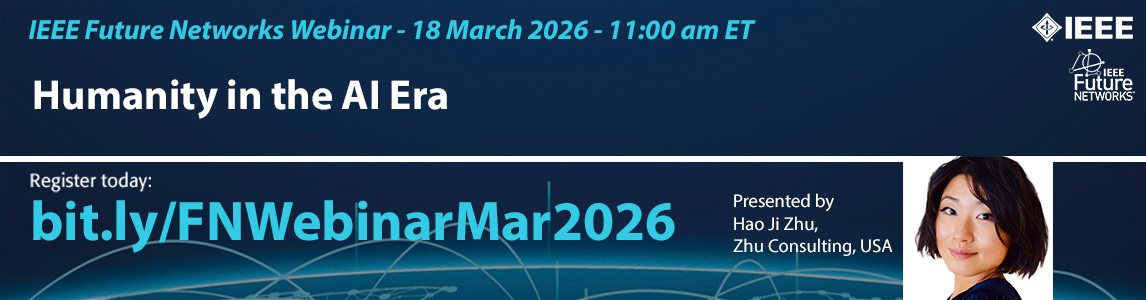
Abstract: The current era of rapid AI evolution presents both promising benefits and complex risks. Global conversations increasingly recognize ethics as an essential foundation for successful AI adoption, affirming a humanity-centered approach for collective betterment. This talk explores what this means in practice, reflecting on the broader implications of responsible AI, how technological trajectories can shape societies in materially different ways, and how these ideas connect to widely shared global goals, drawing on some recent examples. Participants will also be encouraged to think through some forward-looking action steps that could help individuals and institutions to better adopt AI responsibly and harness the opportunities this moment presents. The discussion is structured to be accessible for participants across digital literacy levels.
For practitioners shaping AI across industries and domains and the general public, if this resonates, I welcome you to join the discussion.
About the author:
Founder of Zhu Consulting, a strategic advisory firm empowering organizations across sectors worldwide to scale social impact solutions through:
Equipping organizations with strategic precision to navigate complexity and identify high-value engagement opportunities.
Architecting coalitions to transform initiatives into synergetic high-impact multistakeholder cooperation across sectoral, geographic, and conceptual boundaries.
Translating expectations around responsible AI into implementation pathways, including digital literacy, ethical stewardship, alignment research, and multistakeholder partnerships.
Learn more about us and explore how we can support your goals: https://zhuconsulting.com
Subscribe to the Monthly Review, a distillation of emerging trends, cross-sector signals, and practice updates.
Be a guest on our podcast Impact Dialogues with Zhu Consulting, a series dedicated to leadership dialogues, success stories, and systems-level insights shaping the future of social impact.
Follow on social media: https://www.linkedin.com/company/zhuconsulting